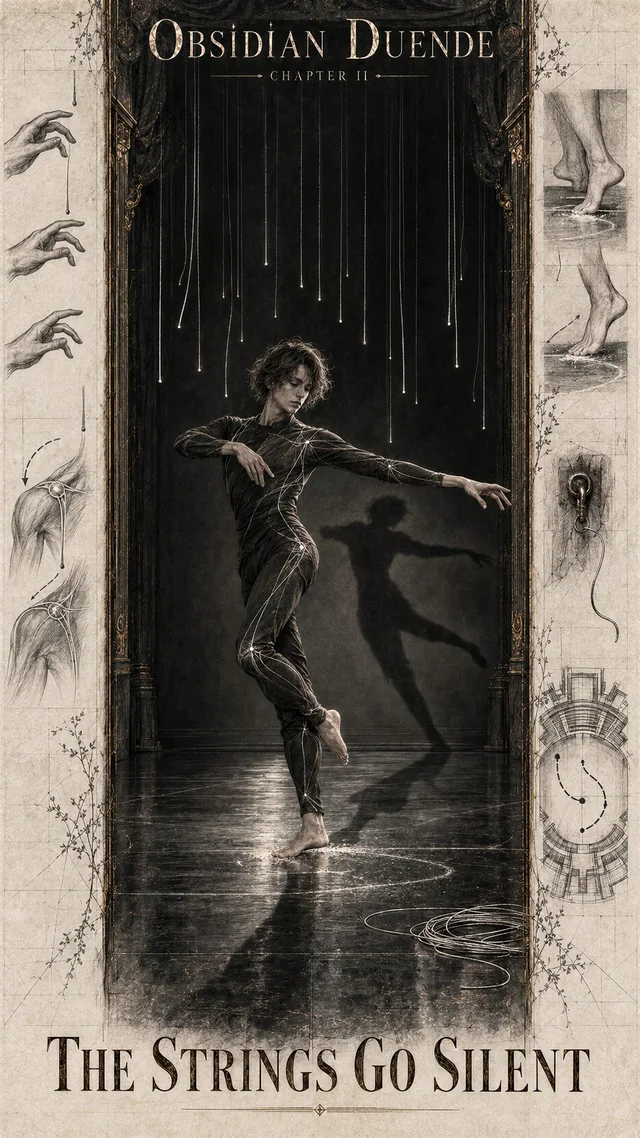
PLATE 02 · GESTURE / THREAD / SHADOW
CHAPTER II · THE LEARNED MOTION
THE
STRINGS
GO SILENT
The strings go silent. Her hands keep moving.
THREE FORMS · THREE RECORDINGS · ONE GESTURE
CHAPTER II · WHEN CONTROL SETTLED INTO THE MUSCLES
The strings
go silent.
She moves flawlessly.
Each turn lands on the beat. Her smile meets the light; every pause lasts exactly as long as the room expects. The audience sees talent. A fine wire tightens beneath her costume.
At first the instructions came from elsewhere.
A script, a watchful eye, the price of a mistake. She was taught where to stop and how deeply to bow. But waiting for every cue would take too long. She learned their order.
Her hands remember the gesture. Her mouth knows the next line. The bow begins before the signal.
Control becomes skill. Skill wins applause, then becomes part of her name. She can no longer always tell where the learned step ends and a choice of her own begins.
One day the theatre empties.
No one gives a cue. The strings are slack. She could stop, but her hands complete the phrase and her head dips toward an empty room.
Perhaps this is her first unprompted gesture.
Perhaps it is simply a motion learned too well. In the silence, the two look the same. What will she do with the next step?
ADAPTED FROM THE OBSIDIAN DUENDE RELEASE STORYBOOK
THE LISTENING ROOM · CHAPTER II
Three views.
Three recordings.
First the dancer speaks. The instrumental recording traces the body's memory without words. Then the voice that once taught her hands replies.
Choose a recording. The music will keep playing while you read or watch the plate.
LOSSLESS EDITIONSFORM 01 · LYRICS
The Strings Go Silent
On stage they call her movement freedom. She hears the word and knows the cost of each gesture.
The light comes on.

My body knows.

Before the cue,

I strike the pose.

I move with the grace
they call my own.

Every turn lands
clean in the glow.

They call it instinct.
They call me a natural.

No one sees the thread
draw tight at my ankle.

Every word polished.
Every pause rehearsed.

I never ask
who is writing the verse.

My hands know the gesture.
My mouth knows the line.

Something beneath them
keeps falling out of time.

A thread at my wrist.

A knot in my throat.

The cue comes softly.

I sing what it wrote.

I dance
on invisible strings,

make surrender
look like art.

The room calls it grace
when the wire draws blood.

I call it freedom

because I must.

I dance
on invisible strings,

smile while the tension
starts to sing.

No hand in the light.

No face I can see.

Only the pull

where my will used to be.

Invisible strings.

Still moving me.

The crowd loves the shape
I give to the light.

They cheer when the wires
hold me upright.

Fame lays gold leaf
over every cut.

No one sees red
when the curtains go up.

They praise the precision,
the poise, the routine,

the beautiful freedom
of moving on cue.

I bow when the shadow
lowers my head.

I rise when it tightens
the line overhead.

Whose hands are these?

Whose breath,
whose name?

If I miss one cue,

does the whole room change?

Whose will is this,

moving under my skin?

And why do I bow

when no one walks in?

I dance
on invisible strings,

make surrender
look like art.

The room calls it grace
when the wire draws blood.

I call it freedom

because I must.

I dance
on invisible strings,

smile while the tension
starts to sing.

No hand in the light.

No face I can see.

Only the pull

where my will used to be.

If I cut one thread,

will I fall...

or awaken?

If I miss one step,

what begins

to break?

When the room is empty,

when no one can see,

why does the music

keep moving through me?

Whose hands are these?

Whose will is this?

Who taught the cage

to feel like skin?

I dance
on invisible strings,

make the fracture
look like art.

The room calls it grace
when the wire draws blood.

I call it freedom

because I must.

I dance
on invisible strings,

but the pull
is beginning to slip.

No hand in the light.

No face I can see.

Only the pull

wearing the shape of me.

No sound.

No cue.

The strings go silent.

My hands

still move.
Загорается свет.
Тело уже знает, как встать.
Сигнал ещё не подан,
а я заняла своё место.

Все называют это моей грацией:
каждый поворот точно попадает в свет.
Для них я родилась танцевать.
Никто не замечает,
как у щиколотки натягивается нить.

Каждое слово отточено,
каждая пауза выучена.
Я редко спрашиваю,
кто написал эту роль.

Руки знают жест,
губы знают реплику.
Но внутри что-то сбивается с такта.
Нить тянет запястье,
в горле затянут узел.
Приходит тихий знак —
и я пою то, что мне велено.

Я танцую на невидимых нитях
и умею превратить подчинение в искусство.
Зал называет это грацией,
даже когда проволока режет кожу.
Я называю это свободой,
потому что должна.

Я улыбаюсь, пока натяжение нарастает.
Ни руки, ни лица в свете не видно.
Осталась только тяга
там, где прежде была моя воля.
Нити всё ещё ведут меня.

Публике нравится силуэт,
который я отдаю свету.
Она хлопает, когда проволока
не даёт мне упасть.
Слава золотит каждый порез;
поднятый занавес скрывает кровь.

Хвалят точность, осанку, привычный рисунок —
красивую свободу двигаться по команде.
Я кланяюсь, когда тень склоняет голову,
и поднимаюсь, когда нить снова натянута.

Чьи это руки?
Чьё дыхание, чьё имя?
Если я пропущу один знак,
изменится ли хоть что-нибудь в зале?
Чья воля движется под моей кожей?
Почему я кланяюсь,
когда никто не входит?

Я танцую на невидимых нитях
и умею превратить подчинение в искусство.
Зал называет это грацией,
даже когда проволока режет кожу.
Я называю это свободой,
потому что должна.

Я улыбаюсь, пока натяжение нарастает.
Ни руки, ни лица в свете не видно.
Осталась только тяга
там, где прежде была моя воля.

Если перерезать одну нить,
я упаду — или проснусь?
Если пропустить один шаг,
что начнёт рушиться?

Когда зал пуст
и никто не смотрит,
почему музыка
всё ещё движется во мне?

Чьи это руки? Чья это воля?
Кто научил клетку
ощущаться собственной кожей?

Я танцую на невидимых нитях
и превращаю трещину в искусство.
Зал называет это грацией,
даже когда проволока режет кожу.
Я называю это свободой,
потому что должна.

Но тяга начинает слабеть.
Ни руки, ни лица в свете не видно.
И только привычное усилие
носит теперь мой облик.

Нет звука. Нет сигнала.
Нити смолкают.
А мои руки
всё ещё движутся.
FORM 02 · THE ARCHITECTURE
Rehearsed Freedom
Without a voice, the same story becomes a movement that no longer waits for a cue.
Listen for the returning impulse: each new gesture seems to begin before the previous one has quite ended.
As the sustained sound recedes, a rhythmic memory remains. The sounding string can disappear without the pattern stopping.
The recording does not decide whether the body is free. It lets you hear how a learned motion could continue in an empty room.
FORM 03 · THE LEARNED RHYTHM SPEAKS / LYRICS
I Taught Your Hands
It taught her precision, then ceased to be necessary. That leaves the question of who owns the gesture now.
You call me strings.

I began
as timing.

One pull.

One turn.

One safer way
to fall.

I held your wrists
until the motion
stopped asking
where to go.

I taught your smile
to find the light.

I taught the bow
to look like choice.

You loved the nights
when nothing slipped.

You loved the freedom
of never missing.

Every perfect step
made one more answer
feel like yours.

You thought
I pulled you.

Later,

you moved
before I could.

I taught your hands.

I taught your turn.

I taught the place
where praise would burn.

I pulled the thread
until the thread

no longer
had to move.

You called it grace.

You called it instinct.

I called it

proof.

You blamed me
when the wire tightened.

You thanked me
when the room applauded.

You feared the hand
above the stage.

You fed it
with every perfect night.

I did not hide
inside your body.

You made a room
for every cue.

You repeated me
until the answer

arrived
before the pull.

When I went silent,

you did not fall.

You finished
the phrase

without me.

I taught your hands.

I taught your turn.

I taught the place
where praise would burn.

I cut the thread.

The thread went still.

Your body
kept the rule.

You called it freedom.

You called it yours.

I called it

proof.

Was I the master?

Or the lesson

you begged
to learn?

Was I the cage?

Or the shape

you practiced
until it felt like skin?

I did not stay.

I did not need to.

I taught your hands.

They kept the time.

I left the stage.

They held the line.

The strings went silent.

You bowed
before the empty room.

You call that freedom.

Perhaps.

But you no longer

needed me.

I cut the strings.

You did not fall.

You moved

exactly

as I taught.
Ты зовёшь меня нитями.
Я начиналась с чувства такта:
один рывок, один поворот,
один способ упасть без боли.

Я держала твои запястья,
пока телу не стало ясно,
куда двигаться дальше.
Я научила улыбку находить свет,
а поклон — выглядеть решением.

Ты любила вечера без ошибок.
Тебе нравилась свобода
ни разу не сбиться.
С каждым идеальным шагом
чужой ответ всё больше казался твоим.

Ты думала, я веду тебя.
Потом ты стала двигаться раньше,
чем я успевала потянуть нить.

Я научила твои руки.
Я научила твой поворот.
Показала, где тебя похвалят.
Тянула за нить так долго,
что ей больше не надо было двигаться.

Ты называла это грацией.
Ты называла это чутьём.
Для меня это было доказательством.

Ты винила меня, когда проволока впивалась,
и благодарила, когда зал аплодировал.
Ты боялась руки над сценой,
но сама кормила её каждым удачным вечером.

Я не пряталась внутри твоего тела.
Ты сама оставляла место для каждого сигнала.
Ты повторяла мои движения,
пока ответ не стал приходить раньше рывка.

Когда я замолчала, ты не упала.
Ты закончила фразу без меня.

Я научила твои руки.
Я научила твой поворот.
Показала, где тебя похвалят.
Потом нить оборвалась,
но тело помнило правило.

Ты назвала это свободой.
Ты сказала: «Это моё».
Для меня это было доказательством.

Была ли я твоей хозяйкой
или уроком, который ты хотела выучить?
Была ли я клеткой
или формой, которую ты повторяла,
пока она не стала похожа на кожу?

Я ушла. Мне не пришлось оставаться.
Я научила твои руки —
они сохранили ритм.
Я покинула сцену —
они держали линию.

Нити смолкли.
Ты поклонилась пустому залу.
Ты зовёшь это свободой.
Может быть.
Ведь я тебе уже не нужна.

Я перерезала нити.
Ты не упала.
Ты двигалась в точности так,
как я тебя учила.
OBSIDIAN DUENDE · THE LOSSLESS ARCHIVE
Keep the
recording.
The whole chapter is here to hear. Choose a recording, chapter, the complete album or the edition with the book.
ORIGINAL RECORDINGS · DIGITAL EDITIONS
Contents, price and availability are checked before checkout.
AFTER THE SILENCE
Whose hands
are these?
Her bow begins before the cue. When did precision become something she could not refuse?
The strings go silent and the room is empty, yet her hands finish the phrase. Is it her first independent gesture or the continuation of practice?
The second voice says she no longer needs it. What would have to change in her next movement for it to be her choice?