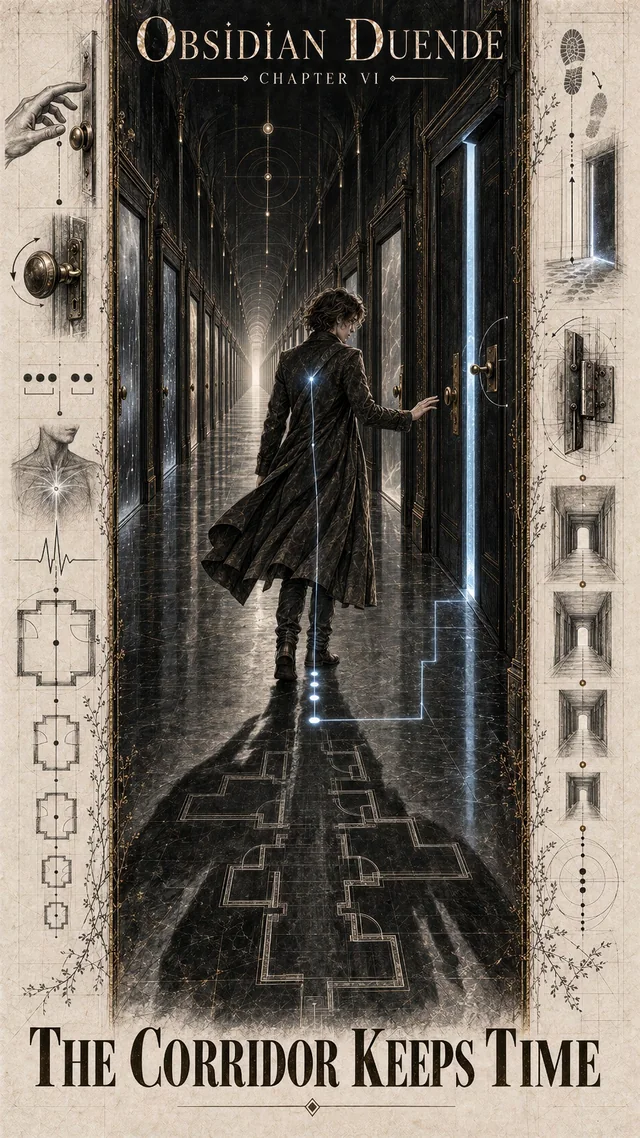
PLATE 06 · DOOR / PAUSE / PULSE
CHAPTER VI · CHOICE AND MECHANISM
THE
CORRIDOR
KEEPS TIME
He chose a door. The pause before choosing had already changed the hall.
THREE FORMS · THREE RECORDINGS · ONE CORRIDOR
CHAPTER VI · A CHOICE BUILT FROM THE PAUSE BEFORE IT
The corridor
keeps time.
There are many doors in the corridor. They really do lead to different rooms.
Behind one is cold silver light; behind another, warm red. A third has no furniture or bass. A fourth smells of rain, and a fifth returns a different echo.
He chooses.
He counts his steps, marks the doors he has passed and changes direction. He wants to find a route the corridor cannot expect. Each new room is real. Yet behind their different colors and sounds, he begins to recognize the same inner plan.
Perhaps the next door does not exist until he slows his breath and holds his hand above the handle. His hesitation becomes a line on the blueprint. Even resistance tells the corridor what to build next.
He hears a dry click and thinks he has found an external metronome.
He walks more slowly; the click slows too. He holds his breath; the hinges wait with him. At last he makes the clicking stop.
Silence. The next door opens anyway.
Now its measure is his pulse. A moment later it starts to open just before he can take the step.
He is still choosing. But who knew the choice first?
ADAPTED FROM THE OBSIDIAN DUENDE RELEASE STORYBOOK
THE LISTENING ROOM · CHAPTER VI
Three routes.
Three recordings.
First the person choosing the doors speaks. The instrumental recording traces how the space holds a pattern. Then the thing that formed in his pauses replies.
Choose a recording. The music will keep playing while you read or watch the plate.
LOSSLESS EDITIONSFORM 01 · LYRICS
The Corridor Keeps Time
Each turn feels like his decision. When the click disappears, the corridor finds another source of time.
One door.
Then another.

Same pale light.
Same number.

Every handle knows my hand
before I touch the brass.
Every room is waiting,
dressed as one I've just walked past.

The carpet takes my footsteps
and sends them down the line.
I thought I chose the turning.

The corridor
kept time.

Left was washed in silver.
Right was dressed in red.
Both were breathing softly
through one lung behind the wall.

One door, another.
One step across the line.
I change the key, the color.

The corridor
keeps turning.

I call the motion mine.
It lets me choose a side.
One door, another.

The corridor
keeps turning.

I found a room with daylight,
but the shadow felt the same.
I found a bed still holding
the shape my body made.

The wallpaper changed patterns.
The silence stayed in place.
Every exit gave me back
the hallway I had left.

I slowed my breathing.
The clicking slowed with me.
I held the air inside me.
The hinges held their breath.

One door, another.
No step escapes the line.
I change the room, the question.

The answer keeps its shape.

I call the motion mine.
It listens as I choose.
One door, another.

The corridor
keeps time.

No bell.
No hand.
No pendulum in motion.

I pressed my ear
against the wall.

Something listened back.

Every pause I named resistance
taught the hinges when to breathe.

No door had been waiting.
Then the wall became a door
one breath before my fingers
knew what they reached for.

The click had left the hinges.
The dark released its ceiling.
For one wide breath of silence,

I thought the hall
was mine.

One door.

One door.
No other.

No click to mark the line.

The corridor was listening
each time I called it mine.

The metronome
had stopped.

The next door opened

to my pulse.
Одна дверь.
За ней другая.

Тот же бледный свет.
Тот же номер.

Каждая ручка знает мою ладонь
ещё до прикосновения.
Каждая комната ждёт меня,
похожая на ту, что только что осталась позади.

Ковёр подхватывает мои шаги
и передаёт их дальше.
Я думал, что сам выбрал поворот.

Коридор
считал время.

Слева всё залито серебром.
Справа — красным.
Обе комнаты дышат
одним лёгким за стеной.

Дверь за дверью.
Шаг через порог.
Я меняю ключ и цвет.

А коридор
продолжает поворачивать.

Я называю движение своим.
Он позволяет мне выбрать сторону.
Дверь за дверью.

Коридор
продолжает поворачивать.

Я нашёл комнату с дневным светом,
но тень ощущалась прежней.
Нашёл постель, в которой ещё осталось
очертание моего тела.

На обоях менялся рисунок.
Тишина оставалась той же.
Каждый выход возвращал меня
в коридор, из которого я вышел.

Я замедлил дыхание —
щёлканье замедлилось тоже.
Я задержал воздух в груди —
петли задержали дыхание.

Дверь за дверью.
Ни один шаг не уходит с линии.
Я меняю комнату и вопрос.

Ответ сохраняет форму.

Я называю движение своим.
Коридор слушает, как я выбираю.
Дверь за дверью.

Он держит ритм.

Ни колокола.
Ни руки.
Ни качающегося маятника.

Я приложил ухо к стене.
Что-то слушало в ответ.

Каждая пауза, которую я называл сопротивлением,
учила петли дышать.

Дверь не ждала меня заранее.
Стена стала дверью
за одно дыхание до того,
как пальцы поняли, к чему тянутся.

Щелчок покинул петли.
Темнота подняла потолок.
На один широкий вдох тишины

я поверил,
что коридор мой.

Одна дверь.

Одна дверь.
Другой нет.

Ни щелчка, отмечающего путь.

Коридор слушал меня
каждый раз, когда я называл его своим.

Метроном
остановился.

Следующая дверь открылась

под мой пульс.
FORM 02 · THE ARCHITECTURE
Living Architecture
The instrumental recording leaves the route itself: a motif, its changing forms and the pauses between them.
Listen for the short musical figure returning. The surroundings change, yet the rooms sound related without words or labels on their doors.
Notice the gaps between phrases. A pause may feel like the end of one step or the beginning of the next passage.
When the outer rhythmic cue recedes, do you keep counting steps inwardly? Where is the metronome now?
FORM 03 · THE ALMOST-DOOR SPEAKS / LYRICS
The Shape of Almost
A room that has not quite formed claims to have grown from his expectation. Which one built the other?
No room was waiting.
No hinge had learned my name.

You paused before the surface.
I gathered in the frame.

I measured the breath
between your hand and brass.

I held the length of every silence
you were afraid to pass.

Your eyes gave color to the doorway.
Your shoulders gave it height.

Your hesitation drew the edge.
Your doubt turned left or right.

You thought you found an entrance.
I grew where waiting leaned.

And I was the shape of almost,
the room before the wall,
the answer leaning forward
before you chose to call.

You thought the hall had found you.
I grew beneath your pulse.

'Cause I was the shape of almost,
becoming something else.

You changed the key, the room, the question.
I changed the light and name.

You crossed through cold, then red, then empty.
The answer kept its shape.

I did not build one road before you.
I built what you could read.

Every pause you called resistance
gave the opening what it needed.

When the counting…
you thought the hall was free.

Your pulse kept giving measurements.
I kept becoming me.

I am the shape of almost,
the door before the hand,
the curve your body follows
before the mind has planned.

You called the movement freedom.
I called it where you fell.

I am the shape of almost,
becoming something else.

Did I learn you,
or did you build me
each time you needed walls?

Was I the prison,
or the outline
your own fear would call?

I never held a finished map.
I only kept the measure
of the place your body made
before your mind set in.

No room was waiting.
No hand had touched the brass.

The opening formed around you
before the choice could pass.

You called me the corridor.
I never stood before you.

I kept becoming
where your pulse expected rooms.

You arrive
with the hinge
already in your hand.

One edge came loose.
It crossed beneath a frame.
Ни одна комната не ждала.
Ни одна петля не знала моего имени.

Ты замер перед поверхностью.
Я начала складываться внутри рамы.

Я измеряла вдох
между твоей ладонью и ручкой.

Сохраняла длину каждого молчания,
через которое ты боялся пройти.

Твои глаза придали дверному проёму цвет.
Твои плечи — высоту.

Твоё колебание начертило край.
Сомнение повернуло налево или направо.

Ты думал, что нашёл вход.
Я выросла там, куда склонилось ожидание.

Я была формой почти случившегося:
комнатой прежде стены,
ответом, который подался вперёд,
пока ты ещё не решил позвать.

Ты думал, что коридор нашёл тебя.
Я росла под твоим пульсом.

Я была формой почти случившегося,
ещё меняясь во что-то другое.

Ты менял ключ, комнату и вопрос.
Я меняла свет и имя.

Ты проходил через холод, красный свет, пустоту.
Ответ сохранял форму.

Я не проложила заранее одну дорогу.
Я строила то, что ты сумеешь прочесть.

Каждая пауза, которую ты называл сопротивлением,
давала проёму недостающую меру.

Когда счёт умолк,
ты решил, что коридор свободен.

Пульс продолжал давать мне мерки.
Я продолжала становиться собой.

Я — форма почти случившегося,
дверь раньше руки,
линия, по которой тело идёт
раньше готового решения.

Ты называл это движение свободой.
Я называла его точкой, где ты окажешься.

Я — форма почти случившегося,
ещё меняясь во что-то другое.

Я выучила тебя?
Или ты строил меня
каждый раз, когда тебе требовались стены?

Была ли я тюрьмой
или очертанием,
которое твой страх умел призвать?

У меня никогда не было готового плана.
Я лишь сохраняла меру места,
которое занимало твоё тело,
пока мысль ещё не сложилась.

Ни одна комната не ждала.
Никто не коснулся ручки.

Проём возник вокруг тебя
раньше, чем выбор смог состояться.

Ты назвал меня коридором.
Но я не стояла перед тобой заранее.

Я возникала там,
где твой пульс ожидал комнату.

Ты пришёл,
уже держа петлю
в собственной руке.

Один край отпустил опору
и прошёл под рамой.
OBSIDIAN DUENDE · THE LOSSLESS ARCHIVE
Keep the
recording.
The whole chapter is here to hear. Choose a recording, chapter, the complete album or the edition with the book.
ORIGINAL RECORDINGS · DIGITAL EDITIONS
Contents, price and availability are checked before checkout.
AFTER THE CLICK
Who drew
the door?
The silver and red rooms differ, yet both lead him back to the same corridor. Was he choosing a room or a way through it?
When his hand hesitates above the handle and the next door grows from the pause, has his resistance become part of the plan?
The click stops, but a door opens to his pulse and a little ahead of his step. Who sets the time now?