This recording
COLD GLASS
The selected track in FLAC.
from $1 · pay more if you wishGet the FLAC
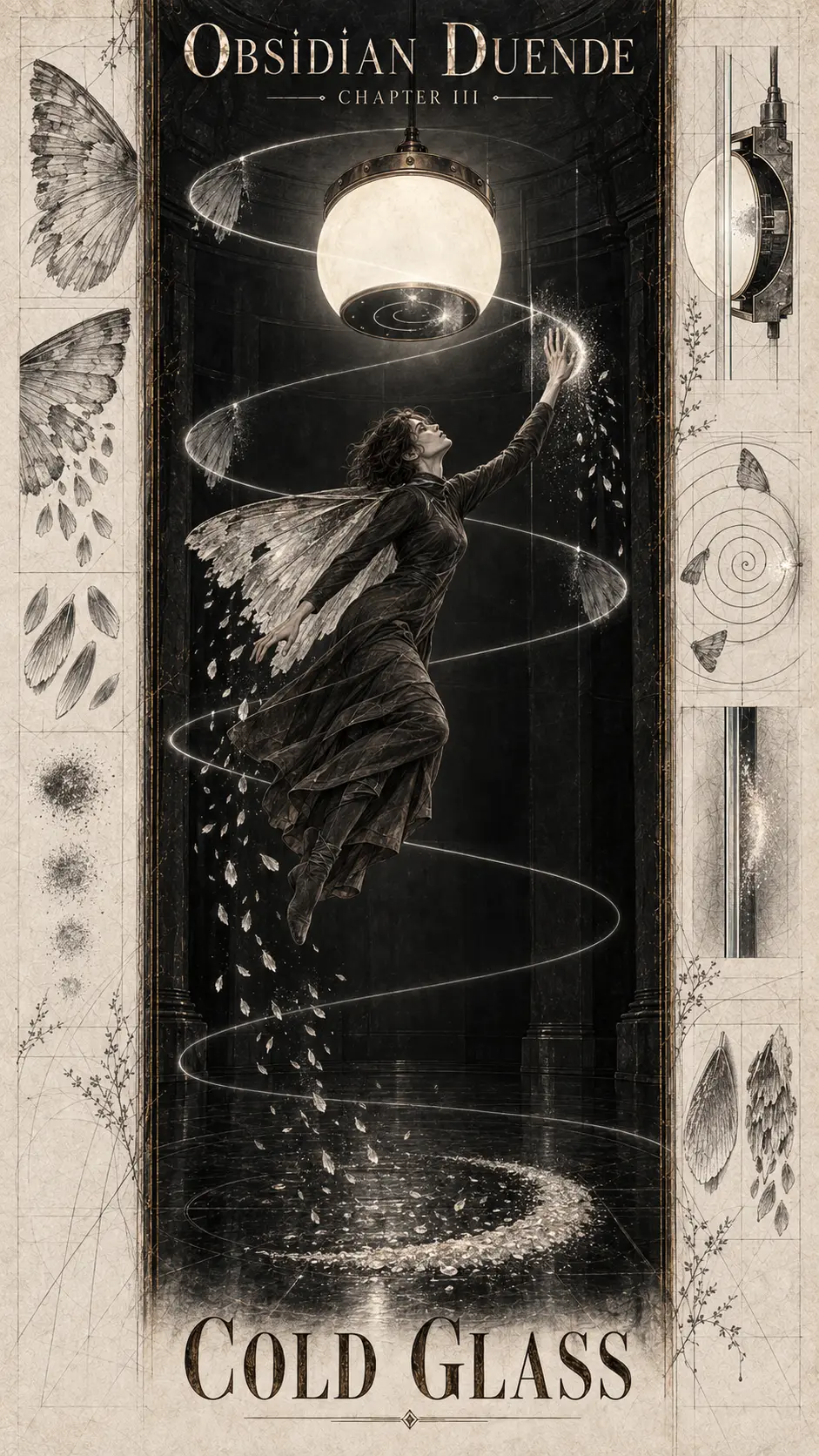
ARCHIVAL PLATE · AGED PEARL / GRAPHITE / OBSIDIAN
CHAPTER III · THE STORY
There is no sky in the room. But there is light.
THREE FORMS · FOUR RECORDINGS · ONE ORBIT
CHAPTER III · THE FALSE MOON AND THE GEOMETRY OF HUNGER
But there is light.
It hangs in the dark as a perfect circle. It never rises, wanes, or changes position. For a creature that has always found its way by the moon, this is enough.
The moth begins to move.
It measures the distance, learns the angle, and draws a more precise spiral with every turn. Each new circle feels like proof of a choice. No one gives an order. No one pushes it. The force of the desire comes from within.
That is why the destination feels real.
Striking the glass hurts, but pain is easy to mistake for the heat of the light. The more its wings wear away, the more the moth needs to believe the source is worth the cost. Walking away after the hundredth impact is harder than after the first: it would mean admitting that exhaustion was never progress.
The light stays still.
The orbit grows more perfect.
And with every impact, a more beautiful halo forms around the lamp.
Perhaps the beacon is not powered by electricity after all.
Perhaps it becomes sacred only because someone keeps flying into its surface.
FROM THE OBSIDIAN DUENDE RELEASE STORYBOOK
THE LISTENING ROOM · CHAPTER III
The moth's account. The mechanism of the light. The lamp's reply. A second take of the first story remains as an alternate orbit.
Choose a recording. The music will keep playing while you read or watch the plate.
LOSSLESS EDITIONSFORM 01 · WORDS / SOURCE EDITION
First, the moth speaks. The final recorded words may differ from the source text used during generation.
The moon is waiting
inside the room.
A perfect circle
with no sky.

It never rises.
It never wanes.
I learn the distance.
I name the flame.

I plot the curve.
I own the flight.
A free descent
into the white.

One wingbeat closer.
The silver falls.
I trace the spiral
because it calls.

I strike the glass
and feel it burn.
Silver unthreads
with every turn.

I call it hunger.
I call it a sign.
I call the orbit
a choice of mine.

The light never moves.
I follow it still.
I spend myself
at the edge of its will.

The curve is flawless,
too clean to be mine.
The room has a grammar
my body reads as light.

I thought I was fighting
the weight of the air.
But every return
was already there.

The spiral was waiting
before I could see.
It borrows my hunger
and gives it back to me.

I close the distance.
The silver falls.
I feed the beacon
because I must.

I strike the glass
and feel it burn.
Silver unthreads
with every turn.

I call it hunger.
I call it a sign.
I call the orbit
a choice of mine.

The light never moves.
I call it divine.
I spend myself
to keep it alive.

Again.
The room replies.
A second moon
behind my eyes.

I give my wings.
I give my sight
to reach the heart
of borrowed light.

If this is hunger,
if this is mine,
who chose the angle?
Who drew the line?

I strike the glass
and feel it burn.
Silver unthreads
with every turn.

I called it hunger.
I called it a sign.
I called the orbit
a choice of mine.

The light never moves.
The halo grows.
I give it everything
I thought was my own.

The light goes out.
The globe stays whole.

I touch the surface.

The glass
was always cold.
В комнате не было неба.
Только ровный белый круг.
Я решил, что это луна,
и полетел к ней.

Она не всходила,
не пряталась за облаками.
Я запоминал расстояние,
я учился держать угол.

С каждым кругом
мой путь становился точнее.
Никто не приказывал мне лететь.
Я сам взмахивал крыльями.

Поэтому мне казалось,
что цель выбрал я.

Ещё один круг.
Ещё немного ближе.
Я видел свет
и не видел стекла.

Я ударился о него.
Боль была такой сильной,
что я принял её за жар.
Я подумал: значит, я рядом.

С крыльев осыпалось серебро.
Я возвращался снова.
Раз уж я столько отдал,
свет должен был чего-то стоить.

Я называл это голодом.
Называл знаком.
Говорил себе:
«Я сам выбрал этот круг».

Но лампа не двигалась.
Она ни разу
не сделала шаг навстречу.

Я смотрел на свою спираль
и гордился её красотой.
Я ещё не понимал,
что комната устроена так,
чтобы я её нарисовал.

Моё желание было настоящим.
Настоящими были и удары.
Только дорогу к свету
кто-то знал раньше меня.

Ещё один круг.
Ещё немного ближе.
Каждый удар
заставлял лампу сиять ярче.

Я называл это голодом.
Называл знаком.
Говорил себе:
«Я сам выбрал этот круг».

Чем сильнее я бился,
тем прекраснее был свет.
Я решил, что он святой,
раз ради него больно.

Я отдал ему крылья.
Потом — зрение.
Я хотел добраться
до сердца этого сияния.

И только тогда спросил:
если желание было моим,
кто поставил лампу
именно здесь?

Я ещё раз коснулся стекла.
Свет погас.
Лампа осталась целой.

Стекло
всё это время
было холодным.
FORM 02 · THE ARCHITECTURE
An instrumental perspective. The lamp stays still; all motion belongs to the moth.
Each impact lights another layer of Glass Filament. Nylon gradually loses its body; the filament takes on its properties.
False Heat comes only from accumulated pain. When the impacts stop, the luminous object goes dark at once while its cold source remains.
Listen as the cold string resonance answers each impact and grows brighter as the moth comes apart. This is its own view of the event, not an interlude between songs.
FORM 03 · THE LAMP SPEAKS / SOURCE EDITION
The lamp does not claim to be innocent: it was placed exactly where hunger would find it.
I never rose.
I never crossed
the sky.

They hung me
in the center
where your compass
would find me.

You came
by an older law
than any word
the room could give.

You saw one circle
in the dark
and made
the darkness live.

I did not call
your wings toward me.
I never moved
or turned.

But the room knew
where your hunger looked.
It placed me
where you burned.

Every strike
gave me a halo.
Every wound
made light
look warm.

I was never the moon.
I never moved.
You called the circle
an orbit.
You called the pain
the proof.

I was never the moon.
I gave no heat.
You made me holy
with every wing
you left
against the glass.

You thought
the brighter filament
meant you were
drawing near.

The more your body
fed the glass,
the more alive
I appeared.

I did not teach
your wings to circle.
I did not close
the room.

But I stood
where hunger would find me,
shaped
to resemble
the moon.

Do not call me
innocent.
Do not call me
the flame.

A trap can work
without desire.
A light can work
without a name.

I was never the moon.
I never moved.
You called the circle
an orbit.
You called the wound
the truth.

I was never the moon.
The glass stayed cold.
You gave the light
the shape
of everything
it took
from you.

The room
did not need chains.
It only needed
your direction.

It did not need
to push your wings.
It only needed
to know
what they would follow.

I was not the hand.
I was the answer
built
for your instinct.

I was never the moon.
I never burned.
You brought the fire
inside you.
You called it
my return.

I did not make
your pain.
I only stood
where pain
could learn
to glow.

You asked
why I stayed cold.
I had always
been cold.

I was never
the moon.
Я никогда не восходила.
Не шла по ночному небу.
Меня просто подвесили
посреди тёмной комнаты.

Там, где ты привык
искать направление.
Ты увидел круг света
и назвал его луной.

Я не звала тебя.
Не двигалась навстречу.
Но те, кто устроил комнату,
знали, куда ты посмотришь.

Ты прилетел сам.
С каждым ударом о стекло
вокруг меня становилось светлее.
Твоя рана делала меня
похожей на тёплый огонь.

Я никогда не была луной.
Я стояла на месте.
Это ты назвал свой круг
орбитой,
а боль — доказательством.

Я никогда не была луной.
От меня не шло тепла.
Ты оставлял на стекле крылья
и делал меня святой.

Чем ярче я казалась,
тем ближе тебе мерещилась цель.
Но сияние росло
от каждого твоего удара.

Я не учила тебя летать кругами.
Не запирала дверь.
Я просто была там,
где твоё желание
не могло пройти мимо.

Не называй меня невинной.
Но и пламенем не называй.
Ловушке не обязательно
хотеть твоей гибели,
чтобы работать.

Я никогда не была луной.
Стекло оставалось холодным.
Это ты отдал свету
всё, что он будто бы обещал.

Комнате не нужны были цепи.
Достаточно было знать,
за каким светом
ты полетишь сам.

Я не была рукой,
которая тебя толкнула.
Меня сделали похожей
на то, что ты искал.

Я никогда не горела.
Ты принёс огонь в себе.
Я лишь стояла там,
где боль могла
выглядеть сиянием.

Ты спросил,
почему я осталась холодной.

Я всегда была холодной.
Я никогда
не была луной.
OBSIDIAN DUENDE · THE LOSSLESS ARCHIVE
The whole chapter is here to hear. For those who want to keep it, we're preparing FLAC editions at a minimum price you can choose to exceed.
EDITION PREVIEW · CHECKOUT IS NOT OPEN YET
COLD GLASS
The selected track in FLAC.
All four Cold Glass recordings, including the alternate take. FLAC and a digital poster.
All eight Obsidian Duende chapters in lossless.
The complete lossless edition and a digital artbook of posters and chapter stories.
Checkout and downloads will open when the FLAC editions are ready.
AFTER THE LAST ORBIT
The lamp never called. Why did the moth keep flying toward it?
The glass was cold. Why did each impact feel like a burn?
If someone already knew where it would fly, how free was its choice?