I chose.
The premise, conflict, characters' voices, sonic direction, selection of versions, meaning of the images and final decisions stayed with me. Sometimes the most important thing I did was say: ‘No. This is beautiful, but it isn't our story.’
OBSIDIAN DUENDE · AFTER THE EPILOGUE
I'm Yuri. I imagined Obsidian Duende and made it with AI: the stories, music, images, short films and the site you are reading now. The machine offered many possibilities. The final choice was mine.
HOW IT HAPPENED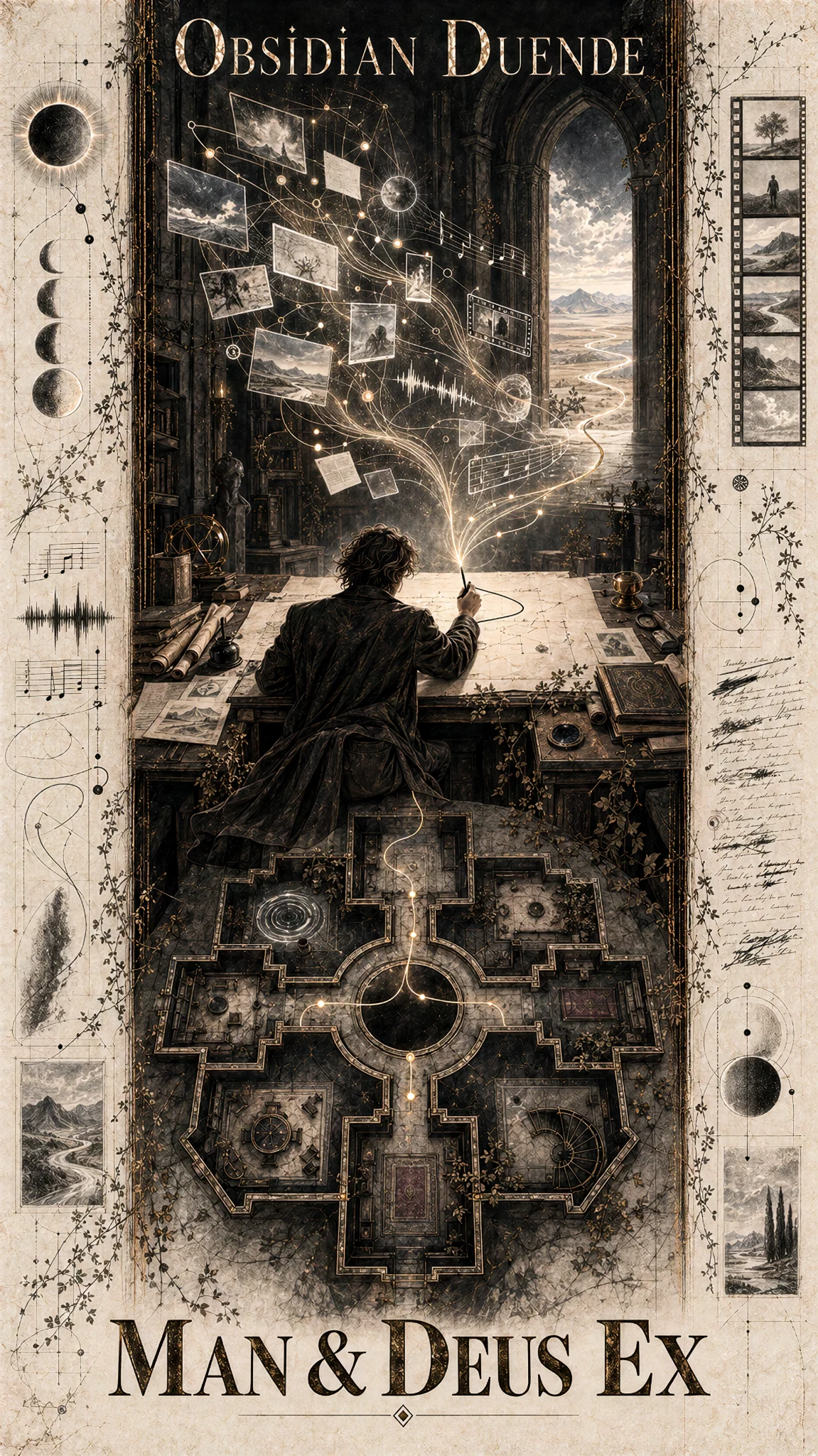
A LETTER FROM BEHIND THE SCENES
How much of what we call our own truly belongs to us? That question became eight connected stories. In the square, answers arrive before the questions. In the final chapter, someone leaves the room and takes a step without a sign.
Each story can be heard from more than one side. There is the person living it. There is the way the event works — sometimes wordless, sometimes with a voice of its own. And there is another witness who changes what seemed certain.
I searched for the right words, rhythm and voice, listened again, and removed even beautiful ideas when they pulled the story elsewhere. Then the music acquired posters and motion. The site became a place to hear a recording and see its meaning change beside it.
No single button assembled this for me. But without AI, I could not have worked through so many possible voices and forms alone.
BEHIND THE IMAGES
Here is the short story of each stage. Open any part you want to explore.
I was building a path through eight rooms, not eight unrelated songs. Each room tests something the traveler believed was his: sight, movement, desire, memory, choice, the right to leave.
In Chapter I he thinks he is the one who noticed the pattern. By Chapter VIII he reaches the open air. His exit is real, but the question of repetition remains. The story does not close with a ready-made answer.
SEE IT IN THE WORK CHAPTER I · THE FIRST COINCIDENCEEach chapter has three forms. The first lives the event from within. The second shows its workings. The third lets someone almost unheard speak. The middle form is usually instrumental; in the eclipse chapter, it sings too.
That is why the versions do not cancel one another. In Cold Glass, the moth, the lamp and another witness speak of closeness, yet none possesses the whole truth. That chapter also has a separate alternate recording.
SEE IT IN THE WORK CHAPTER III · COLD GLASSThe words had to be sung, not read over music. I changed stresses, line lengths and breathing room; searched for a voice, tempo and drum movement that belonged to each scene. AI made it possible to test different generation modes and ideas quickly. Then came the most human part: listening, comparing, rejecting, and returning after a pause.
The final words shown on the pages were checked against the recordings. The Russian readings open up the meaning without posing as another sung original. The instrumentals have listening notes instead of invented lyrics.
SEE IT IN THE WORK CHAPTER IV · THREE ECLIPSE VOICESEach chapter found its own set of objects: a newspaper and a patch of red, strings, a moth by a lamp, black water, a corridor, dust, a road. I set the scenes and selected the images so a poster would add a question rather than merely illustrate a song.
Then the posters moved in short films. You can start and stop the motion; the story remains available if a film cannot play. The cover, chapters and epilogue had to feel like parts of one world.
SEE IT IN THE WORK CHAPTER VIII · THE OPEN ROADI wanted a book you could listen to, not a shelf of tracks. On each page the story sits beside a film; selecting a recording changes its words and notes; the Russian interpretation opens separately. The atlas holds all eight chapters together, and a link can take you straight to a particular recording.
AI helped write and check the code. I chose what the visitor sees and in what order, tested the pages on desktop and phone, and sent them back for revision when the connection between story, sound and controls was lost.
SEE IT IN THE WORK TO THE COVER AND ATLASAfter choosing a version, the sound, file, title, tags, cover and place in the sequence still need care. Each of the 25 audio files has a small line in its comment field. Together, those lines leave another path through the album for anyone who wants to find it.
The versions on this site are here for listening. Lossless editions and buyer downloads are being prepared separately. The edition cards show the plan; checkout is not yet open.
SEE IT IN THE WORK THE LAST PAGEMAN & DEUS EX
The premise, conflict, characters' voices, sonic direction, selection of versions, meaning of the images and final decisions stayed with me. Sometimes the most important thing I did was say: ‘No. This is beautiful, but it isn't our story.’
Models helped draft, test voices and arrangements, explore images, animate scenes and build the site. They returned possibilities quickly; each one still had to be heard, understood, accepted or changed.
I could carry this work because I learned to direct AI well. The result is a whole world made from many decisions.
THE STORY REMAINS OPEN
This is how the rooms were built. Chapter I begins with the person who walked into them.
BEGIN WITH CHAPTER I RETURN TO THE EPILOGUE